Amps to kW: Complete Guide
Learn how to convert amps to kW with the formula, a worked example, and the variables that matter — voltage and power factor. Plain, practical, no fluff.
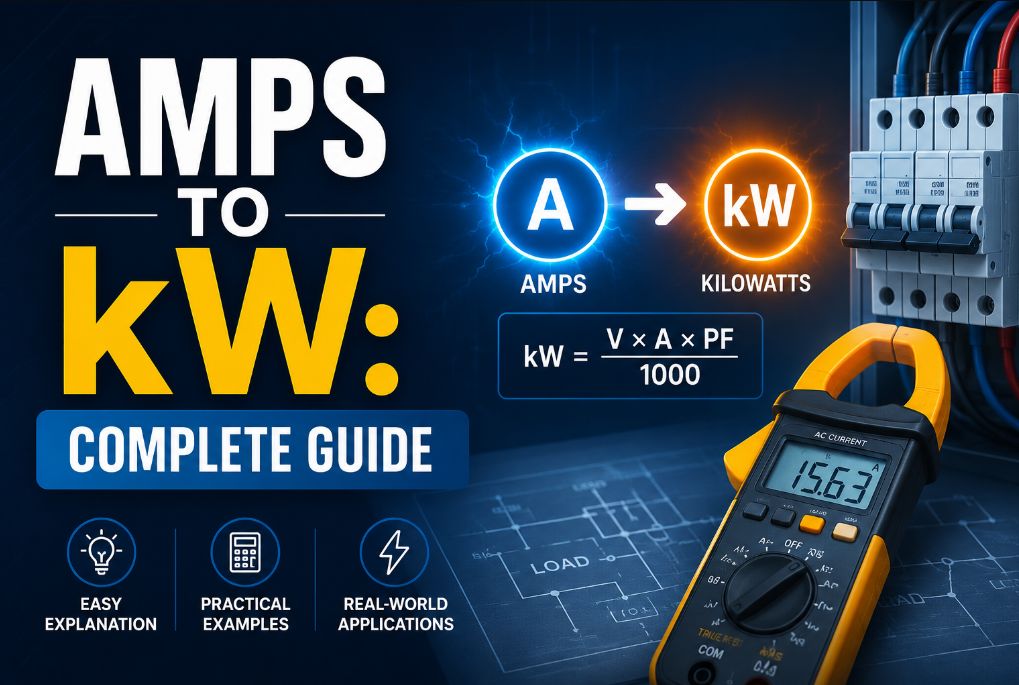
Amps and kilowatts measure two different things, and people mix them up all the time. An amp tells you how much electrical current flows through a wire. A kilowatt tells you how much power that current delivers. One is flow, the other is work. To get from one to the other you need voltage, and in AC systems you need power factor too.
This guide covers the formula, the variables, a full worked example, and the mistakes that trip people up. If you just want a number fast, the amps to kW calculator does it for you.
What amps and kW actually measure
Think of electricity like water in a pipe. Current (measured in amps) is how much water moves past a point each second. Voltage (measured in volts) is the pressure pushing it. Power (measured in watts, or kilowatts for a thousand watts) is the actual work done — heating an element, spinning a motor, lighting a room.
You convert amps to kW when you need to know real power draw: sizing a generator, checking if an appliance fits on a circuit, or planning an electrical install. The current rating alone doesn’t tell you power until you factor in voltage.
The basic formula
For a single-phase AC circuit, the conversion looks like this:
kW = (A × V × PF) / 1000Strip out the power factor and you have the simplest version, which also works for DC:
kW = (A × V) / 1000You divide by 1000 because a kilowatt is 1000 watts. Amps times volts gives you watts (that’s Ohm’s Law at work — power equals current times voltage). Dividing shifts the answer into kilowatts.
Key variables explained
Three values drive the conversion. Get any one wrong and the result is off.
Current (A) — the amperage flowing through the circuit. This is your starting number, usually read off an appliance nameplate or measured with a clamp meter.
Voltage (V) — the electrical pressure. Residential outlets in North America run 120V or 240V. Industrial three-phase systems often use 400V or 480V. Voltage is the bridge that turns current into power.
Power Factor (PF) — a number between 0 and 1 that applies to AC only. In an AC circuit, the voltage and current waveforms can fall out of step. Power factor measures how much of the supplied power does real work. A PF of 1.0 means everything counts. A PF of 0.8 means only 80% converts to real power. Motors, transformers, and fluorescent lighting pull PF down. For DC circuits, there’s no phase shift, so power factor doesn’t apply.
Step-by-step conversion example
Say you have a single-phase motor drawing 20 amps at 240 volts with a power factor of 0.85. Here’s how to work it out.
Step 1 — Plug in the numbers
kW = (20 × 240 × 0.85) / 1000Step 2 — Multiply the top
20 × 240 = 4800. Then 4800 × 0.85 = 4080 watts.
Step 3 — Divide by 1000
4080 / 1000 = 4.08 kW.
| Amps | Voltage | Power Factor | Result |
|---|---|---|---|
| 20 A | 240 V | 0.85 | 4.08 kW |
The motor draws about 4.08 kilowatts of real power. Skip the power factor and you’d get 4.8 kW — nearly 18% too high.
Single phase vs three phase
Single-phase power runs on one alternating waveform. Most homes use it. The formula above covers it.
Three-phase power uses three waveforms offset by 120 degrees, which is why the formula adds a √3 factor (about 1.732):
kW = (A × V × √3 × PF) / 1000Three-phase delivers roughly 1.73 times more power than single-phase at the same current and voltage, which is why factories and data centers use it. That’s a bigger topic — the full breakdown lives in the dedicated three-phase post.
Common mistakes
Forgetting power factor. On AC circuits, leaving out PF inflates your result. A 0.8 power factor means your real answer is 20% lower than the raw amps-times-volts figure. For motor and transformer loads, this matters.
Confusing kVA with kW. Kilovolt-amps (kVA) is apparent power — everything the supply delivers. Kilowatts (kW) is real power — what actually does work. Power factor is the link: kW = kVA × PF. They’re only equal when PF is 1.0.
Mixing up single-phase and three-phase formulas. Using the single-phase formula on a three-phase system leaves out the √3 factor and undercounts power by about 42%. Confirm the phase type before you calculate.
What about amps to kWh?
kW and kWh sound alike but measure different things. A kilowatt is power — the rate of energy use right now. A kilowatt-hour is energy — power used over time. Run a 2 kW load for three hours and you’ve used 6 kWh.
So converting amps to kWh takes one extra step. First find the kW with the formula above, then multiply by the number of hours the load runs:
kWh = kW × hoursAmp-hours (Ah) work the same way for batteries. Multiply amp-hours by voltage, then divide by 1000, to get kWh. A 100 Ah battery at 12V holds 1.2 kWh of energy.
When you’d need this
Appliance sizing. An appliance nameplate lists amps. Convert to kW to check it fits your circuit and to estimate running cost.
Generator sizing. Generators are rated in kW (or kVA). Add up the kW draw of everything you plan to run so you buy enough capacity without overpaying.
Electrical planning. Electricians convert between amps and kW constantly when balancing loads across circuits and confirming a panel can handle the demand.
Try the calculator
Rather than run the math by hand, drop your values into the amps to kW calculator. Pick DC, single-phase, or three-phase, enter your amps and voltage, set the power factor, and it returns the kilowatts.